On this page
Network topology
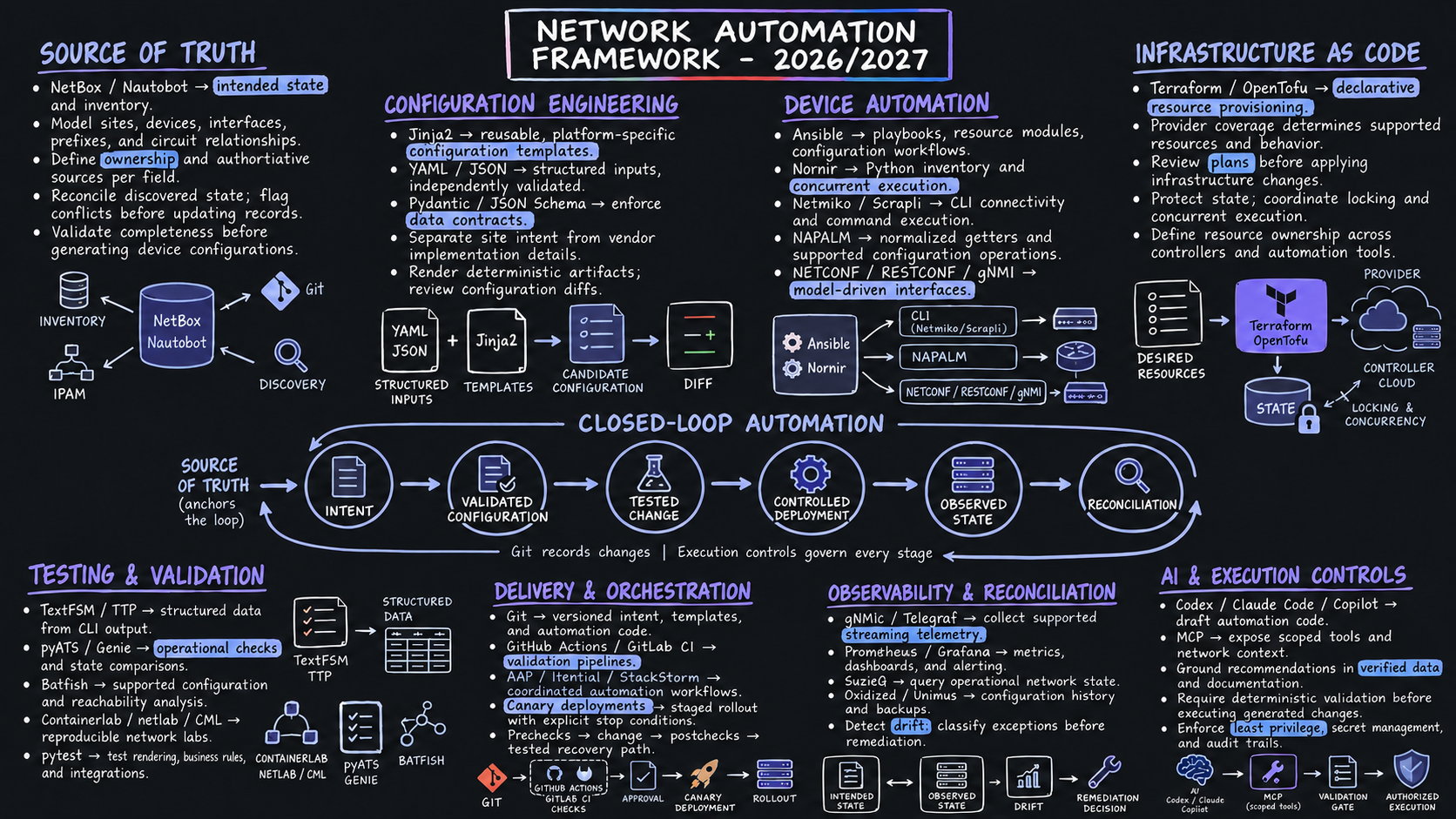
Network Automation Framework - 2026/2027

Source of Truth

  • NetBox / Nautobot β†’ intended state and inventory.
  • Model sites, devices, interfaces, prefixes, and circuit relationships.
  • Define ownership and authoritative sources per field.
  • Reconcile discovered state; flag conflicts before updating records.
  • Validate completeness before generating device configurations.

Configuration Engineering

  • Jinja2 β†’ reusable, platform-specific configuration templates.
  • YAML / JSON β†’ structured inputs, independently validated.
  • Pydantic / JSON Schema β†’ enforce data contracts.
  • Separate site intent from vendor implementation details.
  • Render deterministic artifacts; review configuration diffs.

Device Automation

  • Ansible β†’ playbooks, resource modules, configuration workflows.
  • Nornir β†’ Python inventory and concurrent execution.
  • Netmiko / Scrapli β†’ CLI connectivity and command execution.
  • NAPALM β†’ normalized getters and supported configuration operations.
  • NETCONF / RESTCONF / gNMI β†’ model-driven interfaces.

Infrastructure as Code

  • Terraform / OpenTofu β†’ declarative resource provisioning.
  • Provider coverage determines supported resources and behavior.
  • Review plans before applying infrastructure changes.
  • Protect state; coordinate locking and concurrent execution.
  • Define resource ownership across controllers and automation tools.

Testing & Validation

  • TextFSM / TTP β†’ structured data from CLI output.
  • pyATS / Genie β†’ operational checks and state comparisons.
  • Batfish β†’ supported configuration and reachability analysis.
  • Containerlab / netlab / CML β†’ reproducible network labs.
  • pytest β†’ test rendering, business rules, and integrations.

Delivery & Orchestration

  • Git β†’ versioned intent, templates, and automation code.
  • GitHub Actions / GitLab CI β†’ validation pipelines.
  • AAP / Itential / StackStorm β†’ coordinated automation workflows.
  • Canary deployments β†’ staged rollout with explicit stop conditions.
  • Prechecks β†’ change β†’ postchecks β†’ tested recovery path.

Observability & Reconciliation

  • gNMIc / Telegraf β†’ collect supported streaming telemetry.
  • Prometheus / Grafana β†’ metrics, dashboards, and alerting.
  • SuzieQ β†’ query operational network state.
  • Oxidized / Unimus β†’ configuration history and backups.
  • Detect drift; classify exceptions before remediation.

AI & Execution Controls

  • Codex / Claude Code / Copilot β†’ draft automation code.
  • MCP β†’ expose scoped tools and network context.
  • Ground recommendations in verified data and documentation.
  • Require deterministic validation before executing generated changes.
  • Enforce least privilege, secret management, and audit trails.
1. Network Automation Technologies#

  • Core Automation tools: Ansible, Red Hat Ansible Automation Platform, Nornir.
  • Python libraries: Netmiko, Scrapli, NAPALM, ncclient.
  • Source of truth: NetBox, Nautobot, Infrahub.
  • Configuration templates and parsing: Jinja2, TextFSM, TTP, ntc-templates.
  • Infrastructure as code: Terraform, OpenTofu, Pulumi.
  • Testing and validation: pyATS, Genie, Batfish, pytest.
  • Labs as code: Containerlab, netlab, Cisco Modeling Labs.
  • Git and automation pipelines: GitHub Actions, GitLab CI/CD, pre-commit.
  • APIs and model-driven automation: REST APIs, NETCONF, RESTCONF, YANG, gNMI.
  • Telemetry and network visibility: gNMIc, Telegraf, Prometheus, Grafana, SuzieQ.
  • Configuration backups: Oxidized, Unimus.
  • Workflow orchestration: Itential, StackStorm, Rundeck.
  • Top Vendor ecosystems: Cisco Catalyst Center APIs, Cisco Meraki APIs, Arista AVD and CloudVision, Juniper PyEZ and Apstra, F5 AS3.
  • AI-assisted automation: Codex, Claude Code, GitHub Copilot, network-focused MCP servers.

2. NetDevOps Framework#

Network topology
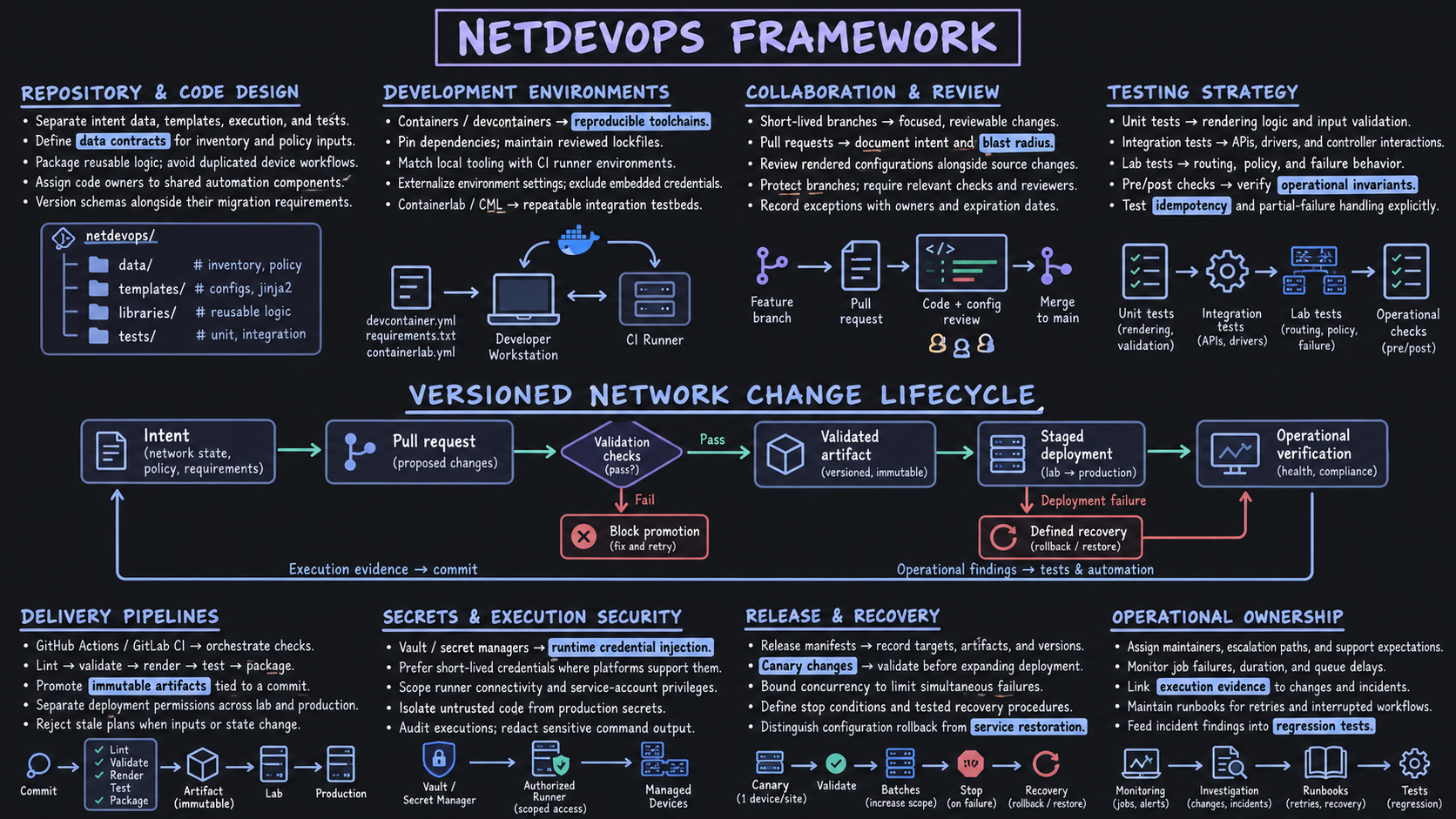
NetDevOps Framework

Repository & Code Design

  • Separate intent data, templates, execution, and tests.
  • Define data contracts for inventory and policy inputs.
  • Package reusable logic; avoid duplicated device workflows.
  • Assign code owners to shared automation components.
  • Version schemas alongside their migration requirements.

Development Environments

  • Containers / devcontainers β†’ reproducible toolchains.
  • Pin dependencies; maintain reviewed lockfiles.
  • Match local tooling with CI runner environments.
  • Externalize environment settings; exclude embedded credentials.
  • Containerlab / CML β†’ repeatable integration testbeds.

Collaboration & Review

  • Short-lived branches β†’ focused, reviewable changes.
  • Pull requests β†’ document intent and blast radius.
  • Review rendered configurations alongside source changes.
  • Protect branches; require relevant checks and reviewers.
  • Record exceptions with owners and expiration dates.

Testing Strategy

  • Unit tests β†’ rendering logic and input validation.
  • Integration tests β†’ APIs, drivers, and controller interactions.
  • Lab tests β†’ routing, policy, and failure behavior.
  • Pre/post checks β†’ verify operational invariants.
  • Test idempotency and partial-failure handling explicitly.

Delivery Pipelines

  • GitHub Actions / GitLab CI β†’ orchestrate checks.
  • Lint β†’ validate β†’ render β†’ test β†’ package.
  • Promote immutable artifacts tied to a commit.
  • Separate deployment permissions across lab and production.
  • Reject stale plans when inputs or state change.

Secrets & Execution Security

  • Vault / secret managers β†’ runtime credential injection.
  • Prefer short-lived credentials where platforms support them.
  • Scope runner connectivity and service-account privileges.
  • Isolate untrusted code from production secrets.
  • Audit executions; redact sensitive command output.

Release & Recovery

  • Release manifests β†’ record targets, artifacts, and versions.
  • Canary changes β†’ validate before expanding deployment.
  • Bound concurrency to limit simultaneous failures.
  • Define stop conditions and tested recovery procedures.
  • Distinguish configuration rollback from service restoration.

Operational Ownership

  • Assign maintainers, escalation paths, and support expectations.
  • Monitor job failures, duration, and queue delays.
  • Link execution evidence to changes and incidents.
  • Maintain runbooks for retries and interrupted workflows.
  • Feed incident findings into regression tests.